THE IRON SENSEI JOURNAL
Karate. Health. Fitness. Psychology. Philosophy. Reflections from a Life in the Martial Arts.
Busaganashi: Water, Ice, and the Spirit of Goju-Ryu
By Jonathan Lowell ("The Iron Sensei")
For most of my karate life, I believed Busaganashi was a male figure associated with fire.
That was the explanation I inherited through years of Goju-Ryu training. Like many practitioners, I connected the image to fighting spirit, determination, and the traditional fire symbolism displayed in many Goju dojos, where the upside-down kanji for fire reminds us that fire naturally rises upward.
I never questioned it.
Only recently, through the research and writings of respected senior practitioners, did I encounter another possibility—that Busaganashi may originally have been understood as a female figure connected to water, the sea, and the maritime traditions of Southern China.
Whether this interpretation ultimately proves historically correct remains an open question. This article is not intended to settle that debate. Rather, it explores how this emerging perspective inspired me to reconsider one of Goju-Ryu's most intriguing symbols and what it may teach us today.
The Sea and the Bubishi
Some researchers believe the origins of Busaganashi may be connected to the maritime culture of Fukien (Fujian) Province in Southern China.
Long before karate was formally organized in Okinawa, the coastal communities of Southern China depended upon the sea for transportation, trade, fishing, and survival. The ocean provided abundance, but it could also bring storms, shipwrecks, and death.
Throughout maritime cultures, protective deities were revered by fishermen, sailors, merchants, and seafaring families. It is possible that the figure known as Busaganashi originated within this broader Southern Chinese tradition before finding its way into the Bubishi and eventually into Okinawan martial culture.
Whether this interpretation is historically correct remains open to discussion. What is beyond dispute is the profound relationship between Okinawa and Southern China.
For centuries, Okinawa served as a crossroads linking China, Japan, and Southeast Asia. Chinese merchants, diplomats, physicians, craftsmen, and martial artists crossed these waters regularly. Along with trade came philosophy, medicine, culture, and martial traditions.
Karate itself emerged from this exchange.
Chojun Miyagi and Busaganashi
One reason Busaganashi remains significant within Goju-Ryu is the apparent regard Chojun Miyagi held for the figure.
Miyagi Sensei studied the Bubishi extensively and reportedly commissioned a statue based upon the Busaganashi illustration found within its pages, displaying it in his dojo.
Senior practitioners have also related that Miyagi occasionally lit incense before the figure, treating it with quiet respect. Whether viewed as a spiritual symbol, cultural artifact, or source of inspiration, Busaganashi clearly occupied an important place within Miyagi's personal relationship with the Bubishi.
The fact that he preserved the image in three-dimensional form suggests that he saw something meaningful within it. Exactly what that meaning was remains open to interpretation, yet the figure continues to inspire generations of Goju-Ryu practitioners.
The Sai and the Sea
The Sai provides another intriguing connection.
Today the Sai is recognized as one of Okinawa's most iconic weapons. While its precise origins remain debated, its resemblance to the trident is unmistakable.
Across many cultures, the trident has symbolized the sea, navigation, protection, and maritime power. Whether symbolic or coincidental, the visual relationship between the Okinawan Sai and the maritime traditions of Southern China invites reflection.
Water and the Three Battles
This perspective led me to contemplate Busaganashi through the Water Element.
Water is one of nature's greatest teachers.
When heated, water becomes steam.
When cooled, water becomes ice.
Gas.
Liquid.
Solid.
Three forms.
One substance.
Within Goju-Ryu, this immediately reminds me of Sanchin—the Three Battles.
Traditionally, Sanchin represents the unification of mind, body, and spirit. Yet as I reflected upon Busaganashi, another meditation emerged.
Like water, the martial artist must learn to express different states of energy.
Like steam, we become light, expansive, and elusive.
We move like clouds drifting across the sky.
Like water, we flow.
We redirect force, adapt to changing circumstances, and strike with the continuous power of a wave.
Like ice, we become focused, condensed, and decisive.
At the moment of impact, softness transforms into hardness.
Move like the cloud.
Flow like the water.
Strike like the ice.
Gas.
Liquid.
Solid.
Soft.
Flowing.
Hard.
Three expressions of one underlying force.
Perhaps this too is a way of contemplating Sanchin—not as three separate qualities, but as three states of one unified spirit.
The Spirit of Goju
The same principle exists throughout Goju-Ryu itself.
Go means hard.
Ju means soft.
Most people think of these as opposites.
I do not.
Like water and ice, they are simply different expressions of the same reality.
Water yields.
Steam expands.
Ice endures.
Each possesses its own strength.
None exists without the others.
My Interpretation
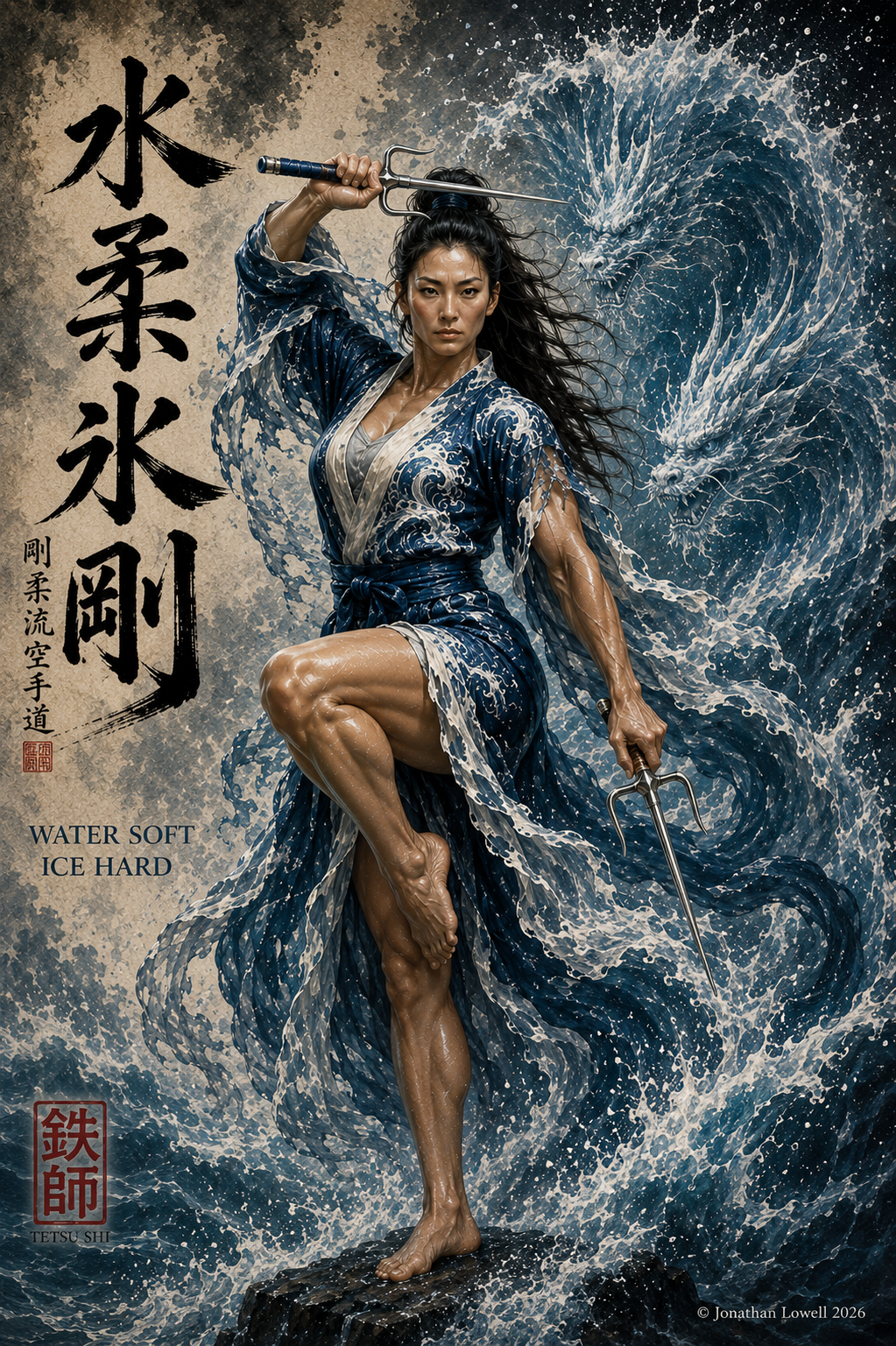
This understanding inspired my artistic interpretation of Busaganashi.
In my painting, Busaganashi appears as a powerful female guardian balanced in the traditional posture. She carries Sai representing both Okinawan martial culture and possible maritime symbolism. Behind her rises a great ocean wave from which a dragon emerges.
The dragon is not separate from the sea.
It is the spirit of the sea itself.
The ocean rages.
The dragon moves.
Yet Busaganashi remains perfectly balanced.
The accompanying phrase reads:
Water Soft — Ice Hard
To me, these words express the essence of Goju-Ryu.
Softness and hardness.
Movement and stillness.
Adaptability and strength.
Different expressions of one reality.
This artwork is not intended as a historical reconstruction. Rather, it is my personal reflection, inspired by the Bubishi, Okinawan tradition, Southern Chinese influences, and more than fifty years devoted to the study of Goju-Ryu Karate-Do.
Final Thoughts
Whether Busaganashi ultimately proves to have been associated with fire, water, or another tradition entirely remains a question for continued research.
For me, however, the greater value lies not only in discovering history, but in allowing history to deepen our practice.
Like water, we must learn to adapt.
Like steam, we must learn to expand beyond our limitations.
Like ice, we must learn to become focused and enduring.
And like Busaganashi, we must remain balanced amid the storms of life.
Perhaps that is the enduring spirit of Goju-Ryu.
Osu.
About the Author
Jonathan Lowell ("The Iron Sensei") has practiced Goju-Ryu Karate-Do for more than fifty years. A lifelong student of Okinawan karate, the Bubishi, martial history, and traditional training methods, he writes The Iron Sensei Journal to explore the history, philosophy, health, and enduring lessons of the martial arts.
© Jonathan Lowell 2026